LIGO Precision. Vertical motion short for social feeds · Art direction, animation, sound and edit
// The idea
LIGO is one of the most precise instruments ever built, and its headline number is almost impossible to feel: it can register a change about 1/10,000 the width of a proton. I set myself a brief with no client attached. Make that number land in 30 seconds, on a phone, and end on a question people want to answer.
// The story, beat by beat
Social video lives or dies in the first seconds, so the piece leads with the punchline and then earns it.
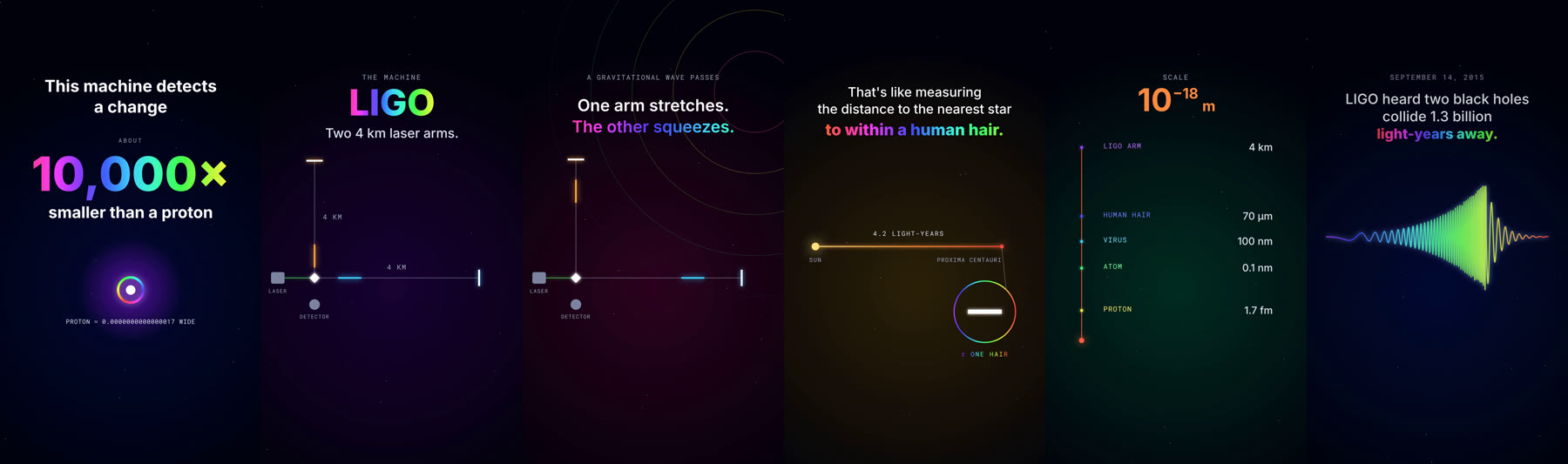
The hook. The number comes first: this machine detects a change 10,000 times smaller than a proton.
The machine. Two 4 km laser arms. Light goes out, bounces back, and the two trips are compared.
The mechanism. A gravitational wave passes: one arm stretches, the other squeezes.
The analogy. It is like measuring the distance to the nearest star, 4.2 light-years away, to within a human hair.
The scale ladder. A countdown in powers of ten, from 103 m to 10-19 m, passing a hair, a virus, an atom and a proton before landing on LIGO's precision.
The payoff. September 14, 2015: LIGO heard two black holes collide 1.3 billion light-years away.
The loop. The opening question returns: could you notice a change 10,000 times smaller than a proton? Guess how it works. Drop your answer below.
Six beats of the short: hook, machine, mechanism, analogy, scale ladder, payoff.
// Design decisions
A world per beat. The near-black background shifts hue from scene to scene, from deep blue to violet to warm amber to green to teal, so each idea feels like a new room and the eye resets.
Spectrum reserved for what matters. The iridescent gradient appears only on the words and numbers I want remembered: 10,000x, LIGO, the human hair, light-years away. Everything else stays white or quiet.
Monospaced microlabels. Small spaced-out captions (THE MACHINE, SCALE, ABOUT) give the piece an instrument-panel feel and tell the viewer where they are without extra words.
Honest about the animation. The arm movement is far larger than reality, so the screen says so: motion heavily exaggerated. A science explainer earns trust by labeling its own shortcuts.
Type does the talking. Every beat is carried by large, short lines of on-screen type, so the story reads with the sound off, which is how many people watch.
Bookended. The proton mark and the 10,000x stat open and close the piece, so the last frame resets the viewer to the question and the loop invites a replay.
// How it was made
I owned the work end to end: the concept and beat sheet, the visual system, the animation and timing, and the final edit. Production combined Adobe Creative Cloud with code-driven animation, which let me tune timing precisely and re-render quickly as the pacing tightened. AI and cloud tools supported specific steps:
Claude. Storytelling: shaping the idea into the beat sheet and script.
Perplexity. Fact-checking the science and the figures on screen.
Gemini. A second reviewer on the work.
HeyGen. AI voiceover creation.
Artlist. Licensed music.
The creative direction, design, timing and final decisions are mine.
// The result
31 s
Complete short, hook to question
9:16
Vertical, built for the feed
1
Question that ends the piece and invites a reply
The finished short shows what I do when I set the brief: take a hard idea, find the single image that makes it click, and carry it through concept, design, motion and sound in a format made for the feed.